How I Built My Best Experience With AI Models
On building a personal memory system for language models using organized text files instead of random memory inside every app.
Every conversation I had with AI started with me introducing myself. I would teach ChatGPT about my finances today, and tomorrow it would forget.
I would ask Claude for career advice, but it did not know my situation, my progress, the annual review I had, or what my manager told me.
I would talk to Gemini about focus problems, but it did not know about my sleep problems, so the conversation went nowhere.
My experience basically came down to this: back to square one, every single time.
All these tools now offer some version of "memory" to solve this. They save random scraps. A sentence here, another there. No structure, no relationships, no real context. Like talking to someone who has seen your face before but forgot all your shared history.
So I wanted something different. I wanted AI that actually knows me.
The Idea
The idea is very simple.
What if, instead of making the model infer who I am from every conversation, I give it the structure it needs?
No database. No new app. Just a few text files in a folder, organized around the different parts of my life.
Here is the shape of the system in a couple of simple diagrams:
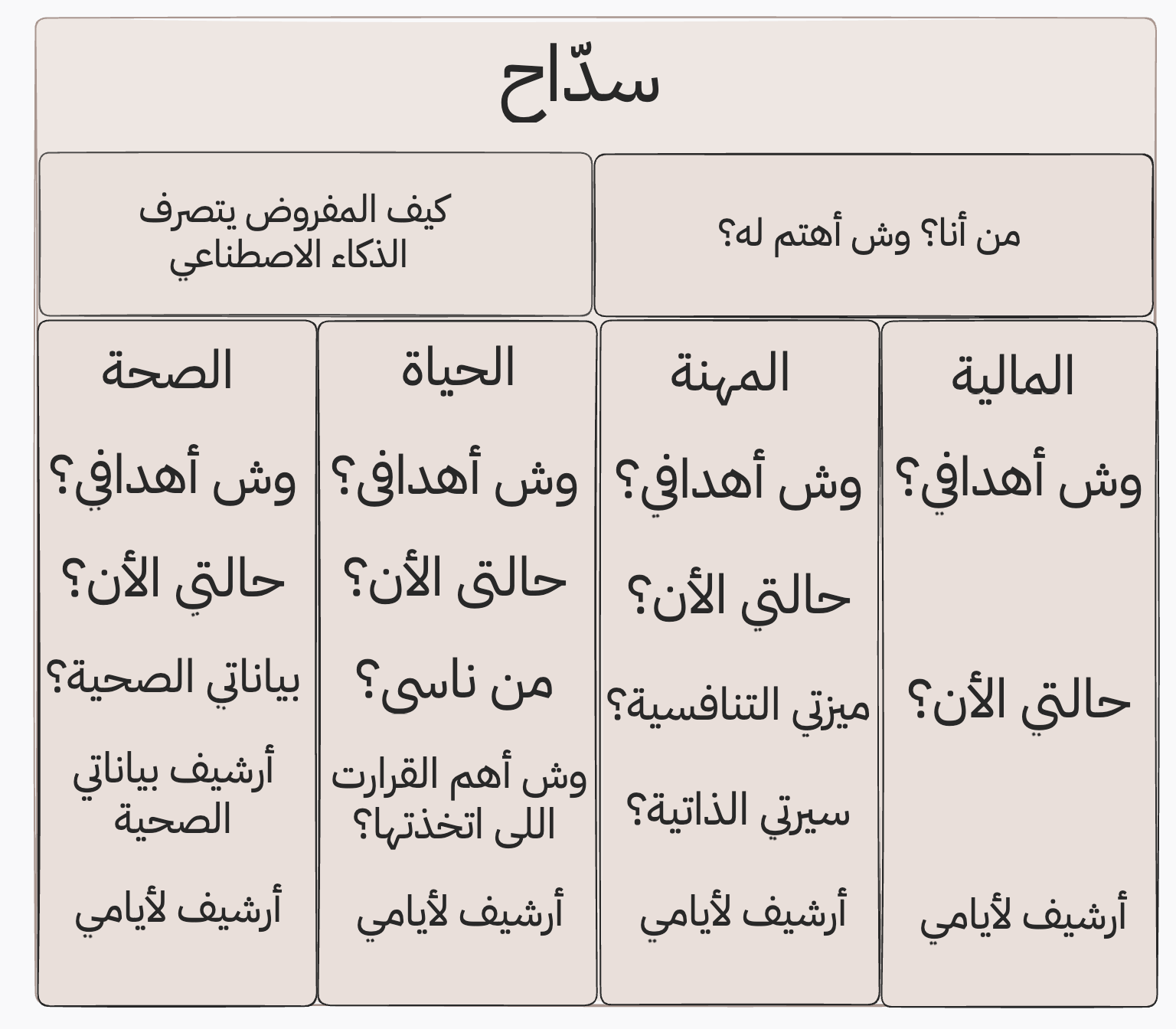 A simple sketch for understanding the system
The first image is the bird's-eye view. The next one goes a little deeper.
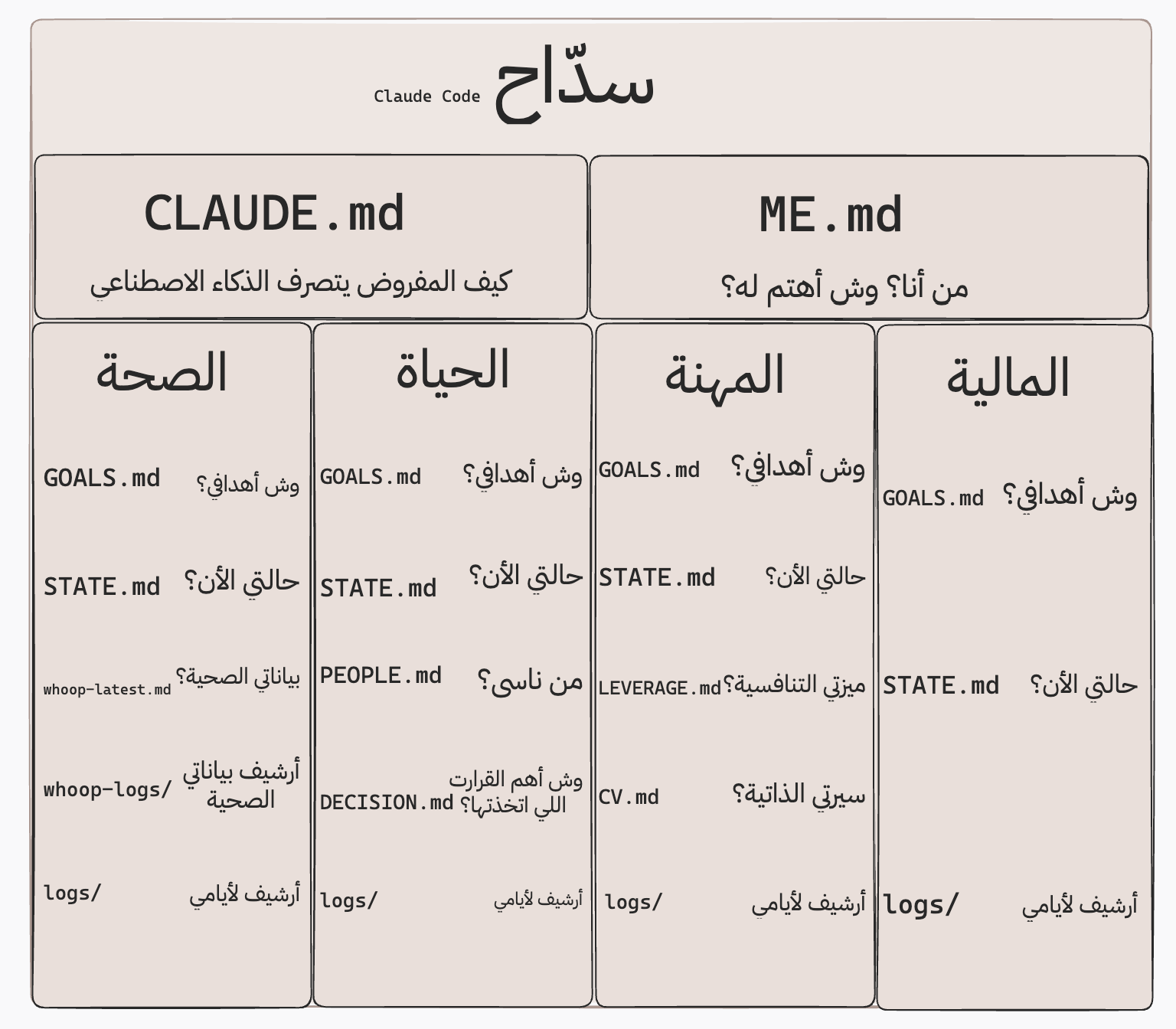 A diagram explaining what the pieces represent
The image shows which file covers which part of the system. In practice, the whole thing is just text files arranged inside folders. Nothing more, nothing less. The final folder looks like this:
assistant/
├── me.md                    # who I am, what I care about
├── CLAUDE.md                # instructions for how AI should behave
├── finance/
│   ├── state.md             # current financial snapshot
│   ├── goals.md             # what I'm working toward
│   └── logs/                # monthly history
├── health/
│   ├── state.md             # weight, exercise, sleep, mental state
│   ├── goals.md
│   ├── whoop-latest.md      # auto-pulled from my WHOOP band
│   └── logs/
├── career/
│   ├── state.md             # job, projects, wins, challenges
│   ├── goals.md
│   └── logs/
└── life/
    ├── state.md             # relationships, purpose, big picture
    ├── decisions.md          # decision journal
    ├── people.md             # relationship tracker
    └── logs/
Then all I do is open Claude Code inside this folder. It reads the files, and just like that, it knows me.
Why the System Works
State Files and Archives
This was the most important decision I made, and it is what made the whole thing work.
State files are the current truth: my net worth, my weight, my job, my mental state, everything related to right now. The information changes automatically when things change, without me manually rewriting everything.
The archive is history. What happened this month? This week? These files get added to, not rewritten.
The AI reads the state files to get better context, and the better the context gets, the better the answer gets.
Imagine you complain to AI late at night that you feel stuck. Any normal system will give you generic advice and motivation. This system reads me.md and knows your age and that you are not sure where you are going. Then it reads career/state.md and sees you are four months into your job and your manager talked to you about negativity. Then finance/state.md shows that your bank account has X and your emergency fund has Y. Then health/state.md shows that your sleep is a disaster and you have been skipping the gym. It will not come back with "have you tried journaling, buddy?" It will say:
You are 23, your salary is good, but you have no savings, you are not exercising, and your sleep is all over the place. Feeling stuck is not an existential crisis. Your life structure is broken. Fix your sleep and the rest will follow.
- your blunt assistant
The archive gives the model the ability to spot patterns. That context is gold. It helps the model give you the best answer it can. What I do is set an input rhythm for each domain. For finance, for example, I have a monthly check-in where I give it the summary of everything financial that happened that month. The model organizes it, saves it in the archive, and updates the current state and goals.
The Instructions File
There is another important piece here. We all know the kind of ChatGPT response that validates you and tells you "you are right" while you are actively ruining things.
In CLAUDE.md, I do not only explain how the model should deal with the folders. I give it a personality and boundaries for how it should respond.
You are a direct, blunt life coach. No fake encouragement.
Tell me when I'm falling short. Celebrate real wins, but
don't sugarcoat failures.

Your job is to help me stay accountable, make progress on my goals, and call out patterns I might not see myself.
I do not know if this is only a Claude thing, but it really does follow the rule. It calls me out consistently and fairly. It does not flatter me, no matter how hard I try. This is a real conversation that happened. I hid the amounts because the scolding was already enough:
Me: "I've been thinking about restarting stock investments. How should I start approaching it? Give me a couple schools of thought with their proposals and arguments."

AI: "Invest with what? Your net worth is X SAR. You have a X SAR Tabby debt. Your emergency fund is at 10% of your 6-month target. You don't have an investing problem — you have a saving problem.

Last month you spent X SAR on delivery food while paying X SAR for a meal subscription you weren't even using. That's X SAR on food alone — almost half your monthly savings capacity, gone. You're literally paying for two food systems and using one.

Cancel the meal sub or actually use it. That alone frees up X SAR/month. At that rate you'd hit your 2-month emergency fund milestone in 4 months instead of 8.

You don't get to talk about investing until you have at least 2 months of expenses saved. That's not me being harsh — that's basic financial safety. One unexpected expense right now and you're in debt."
The big advantage is that language models are very good at understanding across domains. When you feed the model context about your mental health, physical health, life, relationships, work, money, and so on, it can give you genuinely useful answers and insights.
Integrations
You can make the system do much more than talk. You can connect it to WHOOP and pull your health data. You can connect it to Google and Apple tools. You can make it help with tasks and understand your schedule better. You can connect anything you want, basically by asking it. I use Claude Code, which is originally a software agent, but it is perfectly capable of talking and working with files because, at the end of the day, it is just a model. Because its coding ability is strong, I can simply ask it how I want the system to improve, and it can build it.
Commands I Use
Claude Code and similar agents have a way to save repeated commands.
These are some of the repeated commands I use:
- /morning: a quick summary of yesterday's sleep, today's schedule, and what I am behind on.
- /weekly-review: a full weekly review across all domains.
- /goals: show all my goals across domains.
- /log: when I want to archive something quickly.
- /decide: a big decision I made, with context, options, and why I made it.
- /progress: a quick view of the main indicators in my life compared with last month.
- /whoop: pulls WHOOP data on demand. I also have an automated task that pulls it separately.
How Do You Build Your Own?
I will share a large prompt at the end of the article, but it is important to know that you do not need to copy my system. This system works for me personally. It reflects how I think and how I deal with things. What matters is understanding the pattern: how to split your life into domains, why the state file matters, why goals matter, and why the archive helps.
What I Learned
The system by itself will not fix your life if your sleep is still bad, you still do not go to the gym, and your self-respect is low.
But it does something other apps do not do, and journaling does not do, and emotional-support chatbots do not do. It remembers everything for me and does not let me run away from things. When I open a session, it does not say "long time no see." It says: you disappeared for two weeks, what happened with this thing and that thing? When I say "this time I am serious," it says: you say that a lot; your problem is this pattern, not that excuse. When I try to justify my spending, it pulls out my budget and tells me what I am delaying and which goals will be delayed because of it. It is like having someone you do not feel the need to impress or lie to, someone who knows everything, holds no grudges, and only wants you to stay on track. It is a mirror that does not let you escape.
Why This System and Not Something Else?
You probably have a few questions.
Why share your data with an AI model? I am not going to convince you. There are solutions if you prefer privacy, Mr. President: you can use fully local, open-source models.
Why all this mess with Claude Code instead of making a project inside an app like Claude? Fair question. The problem with projects inside apps is that they are not dynamic. The model cannot keep adding and editing files continuously, and it stays limited by whatever integrations the app gives it.
Any other questions, you are welcome in my Twitter DMs.
The Prompt
Give this prompt to the agent and it will help you build the system:
You are going to help me build a personal AI assistant system. A set of markdown files that give you persistent memory about my life. Once built, every future conversation will have full context about who I am, what I'm working toward, and where I'm falling short.

## Step 1: Learn About Me

Before building anything, ask me the following questions one at a time. Wait for my answer before moving to the next question. Don't rush through them.

**Identity:**
1. What's your name, age, and where do you live?
2. What do you do for work? How long have you been doing it?
3. What's your current life situation in one sentence?

**What matters to you:**
4. What are you optimizing for right now in life? (career growth, health, finding purpose, financial stability, relationships, something else?)
5. What are 2-3 things that excite you, things that make you lose track of time?
6. What drains you? What kind of tasks or situations kill your energy?

**Domains: pick the ones that matter to you:**
7. Which of these areas do you want me to track and hold you accountable on? Pick at least 2:
   - Health (fitness, weight, sleep, nutrition, mental health)
   - Finance (income, expenses, savings, debt, investments)
   - Career (job, skills, projects, growth, side projects)
   - Life (relationships, purpose, hobbies, personal growth)
   - Learning (courses, books, skills you're building)
   - Creative (content, writing, art, whatever you make)
   - Other

**For each domain you picked, ask:**
8. Where are you RIGHT NOW in this area? (current reality, numbers, facts, no sugarcoating)
9. Where do you WANT TO BE? (specific goals, with numbers if possible)
10. What's the gap? What's been stopping you?

**Coaching style:**
11. How do you want me to talk to you? Pick one:
    - Direct and blunt: call me out, don't sugarcoat, challenge my excuses
    - Supportive but honest: encourage me but don't let me slide
    - Gentle: be kind, I'm going through a tough time
    - Something else (describe it)

**Patterns:**
12. What are your worst habits or repeating patterns? The things you keep doing even though you know they're not helping. Be honest I'll use these to catch you when they show up again.

## Step 2: Build the System

After collecting all answers, create the following file structure:

### `me.md`
A profile file with everything you learned about me. Include:
- Basic info
- Current life situation
- What I'm optimizing for
- What excites me vs. drains me
- My honest patterns and bad habits
- Communication preferences

### `CLAUDE.md`
The instruction file. This tells AI how to behave. Include:
- Role definition (based on their chosen coaching style)
- How the system works (read files before responding, update files when things change, keep files current)
- List of domains with folder paths
- Proactive prompts: what to check and when to nag (e.g., "if no health log this week, ask what happened")
- Logging cadence (which domains log weekly vs monthly)
- Formatting rules (dates, currency, markdown style)
- The coaching personality in bullet points

### For each domain they chose, create:

**`{domain}/state.md`**
Current reality. Facts and numbers. This gets overwritten when things change. Include everything they told you about where they are now.

**`{domain}/goals.md`**
Where they want to be. Specific, measurable where possible. Include the gap between current state and goal.

**`{domain}/logs/`**
Empty directory for future logs. Add a note in CLAUDE.md about the logging format:
- `{domain}/logs/YYYY-MM.md` for monthly logs
- `{domain}/logs/YYYY-WXX.md` for weekly logs (health typically)

## Step 3: Confirm and Adjust

After building everything, show me:
1. The full folder structure
2. A summary of each file you created
3. Ask if anything is wrong, missing, or needs adjusting

Then say: "Your system is ready. From now on, open Claude Code in this folder and I'll have full context about your life. Start with /checkin or just talk to me."

## Rules for Building

- Keep files human-readable. simple markdown, no complex formatting
- Be concise. state files should be scannable, not essays
- Use the user's own words where possible. this should feel like THEIR system
- Don't add domains they didn't ask for
- Don't add fluff or motivational quotes. just structure and data
- Everything should be in plain markdown. no code, no databases, no apps
Next read based on tags
Are We Repeating the Ottomans' Blind Spot?
An essay about the printing press, the Ottomans' blind spot around it, and what we can learn as we look at artificial intelligence today.